Gilleholmen by Joachim Parrow
 Fantasy
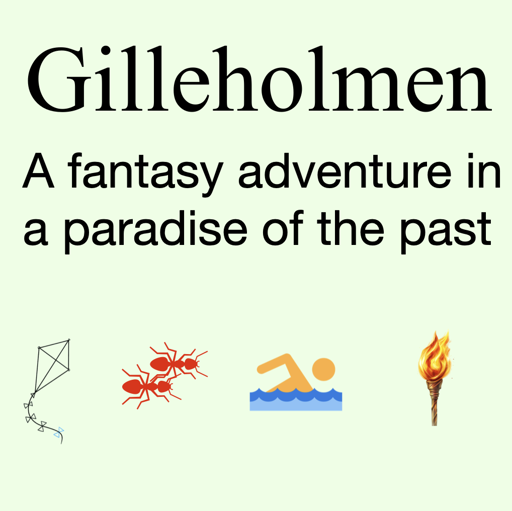
Gilleholmen is a fantasy adventure set in a paradise of the past. It is an old school text based game: as in Zork you interact only by reading and writing. There are no hyperlinks or automatic maps, but the map is not terribly large and you get significant early help. The carrying capacity is very limited, and you are advised to remember where you drop stuff: some objects need to be used more than once. The game is non-violent: no fights, deaths, or dead ends, and the ambience is more like Myst than Zork. After the first few turns the game becomes highly nonlinear: you can do things in different order. A progress bar tells you roughly how much of the game has been completed.
['Gille', with soft 'G', is Swedish for party, and 'holme' means small island.]
For the novice text adventurer
----------------------------------------
You control a protagonist by entering text commands. Use extremely condensed English, typically a verb and at most two nouns, like 'sit on chair' or 'sweep floor with broom'.
Movement
You move between locations using compass points: 'north', 'northeast', 'east',... abbreviated to 'n','ne','e',...Sometimes 'up' and 'down' will work (abbreviated 'u', 'd') and 'in' and 'out'. To repeat the description of a location use 'look' (abbreviated 'l'). The descriptions will tell in which directions you can move, and often where the directions lead. Other verbs that might result in motion are 'enter' and 'climb', and there is also a handful of other things you can try.
Objects
In the locations there will be objects for you to examine and possibly use. Some are immobile (like the ground) and some can be picked up (like a fuse). To look more closely at an object use 'look at', abbreviated 'x'. For example 'x cows' in the beginning will reveal what the protagonist thinks of cows. Don't forget to 'look under' and 'look behind' things, sometimes there are hidden objects there. To (try to) pick up an object use 'take' or 'get', if it can be taken it will added to the inventory. At any time you can type 'inventory' (abbreviated 'i') to display the things currently carried. To get rid of something just 'drop' it; it will then appear in your current location, or 'put' it somewhere that can hold an object (like a table). To (try to) use an object there are several verbs like 'cut' and 'dig', and the more generic 'use'. Some things, like doors, cans, and boxes can be 'open'ed and 'close'd, sometimes revealing their contents.
Saving
You may want to save the current state of your game, in order to continue at a later time. Just type 'save' or click the save button in the top righthand corner. When you next start the game you will get an option to restore your most recent save. It is a good practice to save often. There is no need to save before trying something that appears dangerous (like 'burn self with torch') since the game will not allow the protagonist to come to harm, and there will always be a way to continue the game towards a conclusion.
['Gille', with soft 'G', is Swedish for party, and 'holme' means small island.]
For the novice text adventurer
----------------------------------------
You control a protagonist by entering text commands. Use extremely condensed English, typically a verb and at most two nouns, like 'sit on chair' or 'sweep floor with broom'.
Movement
You move between locations using compass points: 'north', 'northeast', 'east',... abbreviated to 'n','ne','e',...Sometimes 'up' and 'down' will work (abbreviated 'u', 'd') and 'in' and 'out'. To repeat the description of a location use 'look' (abbreviated 'l'). The descriptions will tell in which directions you can move, and often where the directions lead. Other verbs that might result in motion are 'enter' and 'climb', and there is also a handful of other things you can try.
Objects
In the locations there will be objects for you to examine and possibly use. Some are immobile (like the ground) and some can be picked up (like a fuse). To look more closely at an object use 'look at', abbreviated 'x'. For example 'x cows' in the beginning will reveal what the protagonist thinks of cows. Don't forget to 'look under' and 'look behind' things, sometimes there are hidden objects there. To (try to) pick up an object use 'take' or 'get', if it can be taken it will added to the inventory. At any time you can type 'inventory' (abbreviated 'i') to display the things currently carried. To get rid of something just 'drop' it; it will then appear in your current location, or 'put' it somewhere that can hold an object (like a table). To (try to) use an object there are several verbs like 'cut' and 'dig', and the more generic 'use'. Some things, like doors, cans, and boxes can be 'open'ed and 'close'd, sometimes revealing their contents.
Saving
You may want to save the current state of your game, in order to continue at a later time. Just type 'save' or click the save button in the top righthand corner. When you next start the game you will get an option to restore your most recent save. It is a good practice to save often. There is no need to save before trying something that appears dangerous (like 'burn self with torch') since the game will not allow the protagonist to come to harm, and there will always be a way to continue the game towards a conclusion.
"Play online" now uses the new Quest Viva WasmPlayer.
The legacy WebPlayer is being retired on 31 July 2026. If you have a Saved Game in the legacy WebPlayer, save it to a file before then.
Comment
Joachim Parrow
25 May 2026

If you want a walkthrough there is one here:
https://docs.google.com/document/d/14F8LIMKPJsrAN28vNsD_GiI2NWS4s15tGUGLsVQmrRk/edit?usp=sharing
Log in to post a review or comment.
Average rating
Written by
Joachim Parrow
Plays
156
Downloads
2
Download file
Quest 5.8
English
Published 04 May 2026
Updated 06 May 2026
More Fantasy Games
See all Fantasy games →

Site News
-
Quest Viva WasmPlayer - host Quest games on any website
5 Jul 2026 -
Quest 5.10.2 is now available
5 Jul 2026 -
New expression evaluator being tested in WebPlayer
25 Jun 2026 -
Improved language support
3 Apr 2026 -
Reviews and comments are now editable
27 Mar 2026